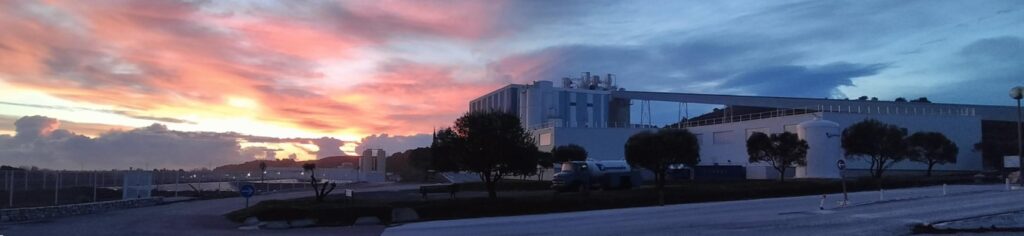


Sites in Pyrénées-Orientales
Exceptional marble from the heart of the Corbières region, brought to life by a factory that is constantly evolving
In the Pyrénées-Orientales, between Espira-de-l’Agly, Tautavel, and Vingrau, Provençale operates three quarries producing some of the purest white marble in Europe: Montpins, Nareda, and Nau Bouques. Just a few kilometers away, our plant—located between Espira-de-l’Agly and Cases-de-Pène—processes this marble into gravel, grit, and powder, which are shipped weekly to hundreds of factories in France, throughout Europe, and as far as the other side of the world.
This geological rarity—exceptional on a European scale and located near a logistics hub—is a boon for the region’s industry: it enables the local supply of a fundamental raw material (calcium carbonate is used in paints, coatings, polymers, food, pharmaceuticals, cosmetics, and agriculture) of a quality high enough to be exported weekly to other continents.
The adjacent grinding plant, which has been continuously evolving for decades, is one of only a handful of plants worldwide capable of industrially producing the most technically advanced calcium carbonate products. To ensure we continue this success for decades to come, our Research and Development center is located on this site.
The methodology for extracting and processing the rock allows this site to produce material with a particularly low CO2 equivalent impact, enabling our customers to develop more sustainable formulations.
Geological History: The Story of a Vanished Ocean
About 145 million years ago, at the end of the Jurassic (Tithonian), and then at the beginning of the Cretaceous (Valanginian, around 135 million years ago), what would later become southern France was still an ocean.
Jurassic (-145 Ma): The formation of the Nau Bouques and Nareda marbles. On the warm, shallow seafloor, marine organisms lived and died over millions of years. The accumulation of their shells formed thick layers which, under their own weight, transformed into limestone sediments: this marked the beginning of sedimentation and, subsequently, diagenesis.
Cretaceous (-135 Ma): The formation of the Montpins limestones. A few million years later, the same process continued, depositing the limestones that would form the Montpins deposit.
Pyrenean tectonics. The separation and subsequent collision between the Iberian and European plates metamorphosed these limestones and, as the Pyrenees mountain range was raised, also fractured them. The recrystallized rock became the luminous white marble we know today.
Millennia of erosion. The erosion of the Corbières mountains gradually brought these marbles to the surface on the garrigue-covered slopes where Provençale quarries them today.
Over the course of millions of years, the random flow of water—carrying away or depositing impurities—has created a deposit here of rare purity. It has therefore been designated a Deposit of National Interest.
Montpins Quarry
Located in the municipality of Espira-de-l’Agly, it is one of the main quarries in the Pyrénées-Orientales department. The open-pit operation, currently in a declining phase, adheres to strict specifications: the product destined for the plant must maintain a consistent whiteness, which requires blending stone from different areas of the deposits. The Montpins quarry exhibits greater heterogeneity than the quarries at Nareda and Nau Bouques; the result is a clear testament to the expertise developed by the teams. Materials that are too weathered are not wasted: they are repurposed as aggregate or riprap, which you’ll find in the department’s infrastructure (roads, riverbanks, etc.).
Nareda Quarry / La Narède
On the hills behind Tautavel, the Nareda quarry lies at the heart of a white marble deposit formed during the Jurassic period. Since 1973, its marble—slightly brighter than that from Montpins—has ensured a long-term supply for the factory and allowed for precise adjustment of the products’ whiteness through blending.
This complementarity between deposits is key to the site’s rarity: few regions in Europe offer, within such a limited area, multiple zones of white marble of this quality.
The volume of material extracted from the Nareda quarry has been higher than expected in recent years in order to compensate for the inability to adhere to the mining schedule at the Nau Bouques quarry. In fact, one of the prefectural permits for this neighboring quarry was suspended pending court decisions from 2015 to 2022.
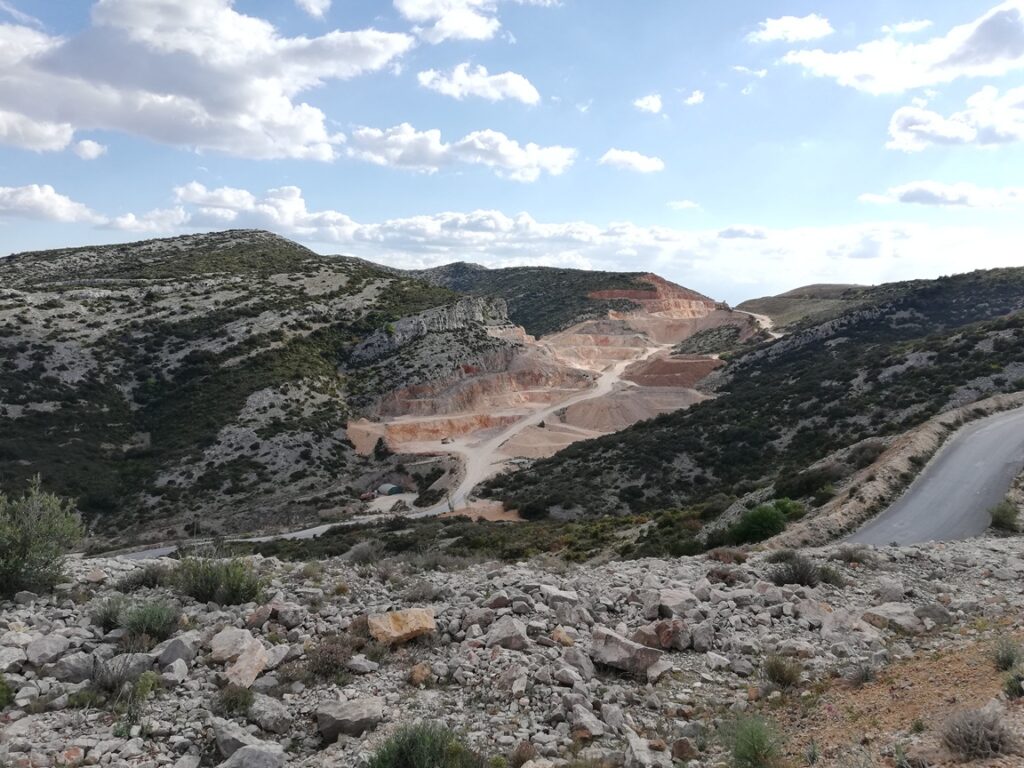
Nau Bouques Quarry
Also located on the Jurassic outcrop, this quarry—in Vingrau and Tautavel—is in fact an eastern extension of the Nareda quarry. In fact, Nareda and Nau Bouques were a single quarry (covered by the same permit) between 1973 and 2004.
In 2005, the two quarries were separated into two distinct cases due to differences in access routes. The Nau Bouques case was then processed after the Nareda case; however, following regulatory changes at that time (and shifts in interpretation), the case evolved through multiple exchanges with government agencies (including a request for the premature closure of the Feyche quarry under the French ERC principle), and the quarry was once again authorized in 2015 (2014 operating permit (ICPE), 2015 decree granting an exemption for protected species).
A few months after all administrative permits were issued, the prefect’s 2015 decision was challenged. The case then spent seven years in the courts. During this protracted legal battle, which helped shape case law regarding quarries (operated by Minéraux Industriels) in France, the Council of State ruled in 2020 (03/06/2020), that this project did indeed serve an overriding public interest, a necessary condition for an exemption order regarding protected species. The case was then referred to the Administrative Court of Appeal in Marseille, which subsequently amended its ruling and dismissed the case primarily on procedural grounds: since best practices for such cases had evolved in the meantime, the format of this case file did not allow the Court to clearly or easily assess the project’s impact on biodiversity.
Since 2023, a new application for an exemption regarding protected species has been under review, accompanied by new inventories of flora and fauna covering their entire life cycles. Following a review by the administration and a favorable opinion from the National Council for Nature Conservation, a new decree was issued in 2026.
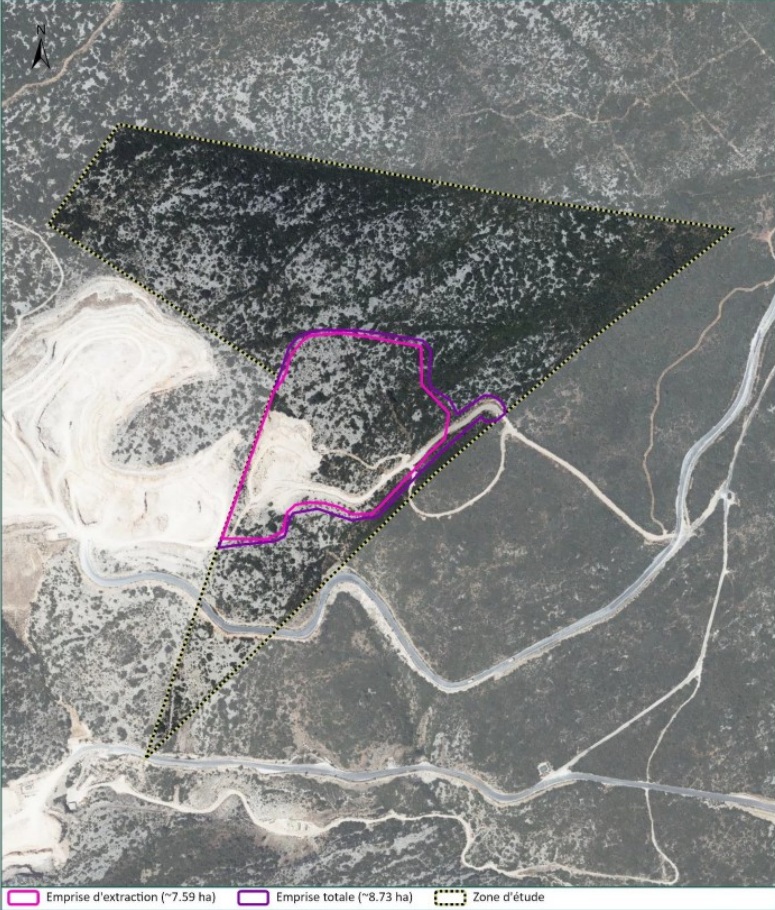
Numerous impact assessments and monitoring studies of this quarry area have identified (confirmed or suspected occurrences of) 1 protected plant species and 44 protected animal species whose habitats or hunting grounds would be affected within the project area (8.8 ha). During quarry operations, the plan is to offset the impacts on these species by adapting 71.5 ha to support them. Finally, during the gradual restoration—as quarrying progresses—we plan to reshape the terrain, notably by creating small terraces to support these species through alternating areas of refuge and hunting grounds (we apologize to the ecologists reading this for this crude simplification of the subject).
This quarry is located near the quarry known as “La Télévision.”
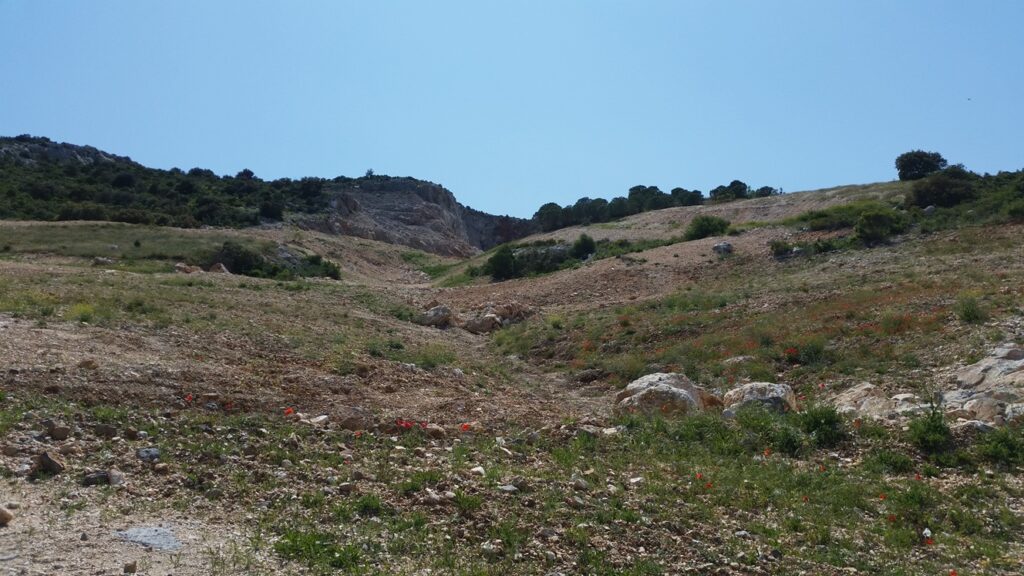
Former Feyche Quarry
Located along the extension of the Jurassic formation (several kilometers east of Nau Bouques), the Feyche quarry was in operation from 1971 to 2015.
During discussions with government agencies regarding the Nau Bouques quarry, it was decided to close the Feyche quarry in order to prioritize operations at Nau Bouques while resources still remained (at the request of the administration to reduce the environmental footprint of the quarries); since the Feyche quarry has a ridge more suitable for raptors and has a greater visual impact when viewed from the Pas de l’Echelle in the municipality of Vingrau. It was restored by reshaping the face (the ridge) and the ground to benefit priority species: A large cliff face for raptors and, on the ground, the creation of heterogeneity (in the shape and nature of the terrain) to create alternating groves and more open, mineral-rich areas for birds and lizards (a significant simplification of this topic).
The Factory: From a Block of Marble to Micronized Powders
Between Espira-de-l’Agly and Cases-de-Pène, just a few kilometers from the quarries, the Provençale plant processes the white marble extracted from the quarries into a complete range of products, from decorative gravel to micronized powders (significantly finer than flour).
Every week, these products are shipped to hundreds of client factories in France, throughout Europe, and even to the other side of the world.
Located as close as possible to the deposit, this proximity between extraction and processing reduces the transport of raw materials and the logistical footprint of the production cycle. The plant is constantly evolving to sustainably improve our competitiveness and the quality of service we provide to our customers.